
How I Coached My ADHD Student Through Finals — and the Framework Any Coach Can Use
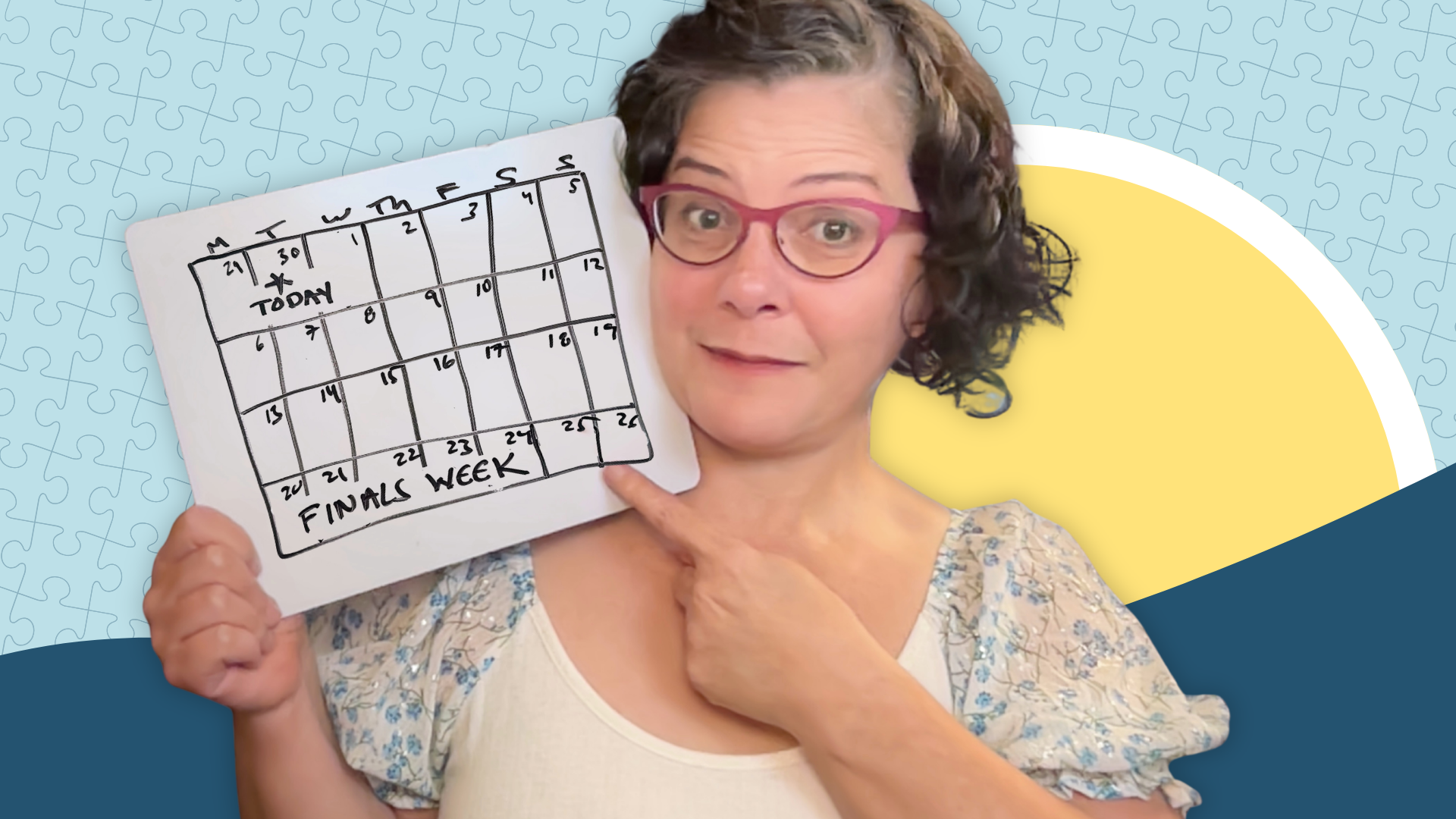
It happened on April 26, 2021 — the moment that makes any coach’s heart go pitter patter.
It was a regular Tuesday session with Olivia, a high school 10th grader I'd been coaching since the end of her 8th grade year.
We did the usual check-in. She reported an A on her history test. Congrats! And then — praise be!! — she told me she wanted to use our session that day to work on a final exam study plan.
What?! Really?! NOW?! A whole 4 weeks before finals?!
In my notes to her parents after the session, I wrote: I am VERY proud of her for wanting to think ahead about finals.
What thrilled me was, specifically, this: Until now this moment, I had always been the one to initiate the “let’s talk about finals” conversation. But this time Olivia brought it up before finals was even on my radar. In April no less!!
How did we go from an ADHD middle schooler in triage mode at the end of 8th grade to one who, two years later, was planning ahead without being asked?
And more importantly, is that kind of shift possible for the students you're working with right now — the ones who are still waiting for you to bring up finals, who equate exam prep with cramming the night before?
Let’s trace Olivia’s finals prep arc during 2.5 years of academic coaching with me — to illustrate how we got from her freaking out to feeling ready and even planning ahead.
This moment with Olivia didn't happen by accident. It happened because of something we'd built, slowly and steadily over three finals seasons working together. Let me show you how.
TL;DR
If you don't have time to read the whole article (I get it!), here are the most important takeaways:
The goal of finals coaching isn't just to help students survive exam season — it's to help them internalize a process so deeply that, eventually, they reach for it themselves. Olivia's story is proof that this kind of shift is possible.
That shift doesn't happen in one session or one finals season. It took 2.5 years of consistent, low-pressure practice before finals were even on Olivia's radar — and then suddenly, it was her idea to study for them.
If you have a student who's still waiting for you to bring up finals, who equates exam prep with cramming the night before — this post is for you. We're tracing Olivia's arc from triage mode to planning ahead, so you can see what that progression actually looks like in real coaching.
This blog may resonate most with:
Academic coaches and executive function coaches preparing students for finals season
ADHD coaches working with neurodivergent students who tend to hit a wall in May
Coach training programs looking for real-world examples of how coaching frameworks develop over time
From Triage to "I've Got This:" Five Finals Seasons with Olivia
8th Grade: First Attempt
When I first started working with Olivia at the end of 8th grade, her family had hired me in the midst of panic. We needed to put out fires so that she could actually graduate from middle school (and yes, these 8th graders had finals). Finals were happening around her, not with her.
After all, I'd only started working with her five sessions before the end of the school year — which meant we were still figuring out "the basics" for an ADHD middle schooler: setting up reminder systems, tracking missing assignments, getting her systems off the ground.
Those five sessions weren't wasted. They were diagnostic.
We learned her patterns — where she dropped the ball, how she thought about (or rather, didn't think about) time, what her planning systems were missing, where ADHD was making things harder than they needed to be.
That data from our first finals season shaped everything that came after, including an intensive summer between 8th and 9th grade where we built the foundations she was missing.
This is the stage I often call "triage coaching" and it is usually a necessary first step of any coaching relationship. Most families, after all, reach out for academic and executive function coaching in a panic, when everything has fallen apart. The next stage, what I call "proactive coaching," happens once the fires are out.
For more about triage versus proactive coaching, you might enjoy this blog post.
9th Grade: Second & Third Attempts
After our first summer, Olivia and I had built a strong relationship, and her parents were happy to re-engage me to support her transition into high school. By December of her 9th grade year, we had enough of a foundation to try a more proactive finals prep process.
I noticed finals were three weeks away before Olivia did. I opened the conversation. I asked the questions. I invited her to office hours to work on an "anti-cram plan" together. We practiced making study tools for each exam she had coming up — all initiated by me.
At the end of our main final exam planning session, Olivia exclaimed:
"I go from having no clue about what's going on to having a clue. I never would've thought to make this chart. I like filling in all the boxes!"
The chart she's referring to is what I now call my Anti-Cram Final Exam Plan — the same plan I teach educators to use in my annual Finals Without Freakout Masterclass. (Click here if you’re reading this before March 24, 2026 and you’re curious about our upcoming masterclass.)
Olivia liked this final exam anti-cram process (as much as a student can like studying!). We repeated it at the end of her freshman year. She engaged with it actively. But the initiating was still entirely mine.
10th Grade: Fourth Attempt
In December of her 10th grade year, we went through the same final exam anti-cram process again — this time with a wrinkle.
Olivia had a friend's birthday party the weekend before finals. When this came up as we mapped out her anti-cram plan, it was clear to me that she wasn't going to be able to study as effectively as she needed to and attend the party. But instead of telling her that directly, I walked her through some strategic questions.
"What do you need to have accomplished before the party in order to give yourself permission to go?" I asked her. As we laid out all her tasks in the anti-cram plan, I watched her start to realize, in real time, that attending the party might be more complicated than she'd thought. Reality set in.
She did still go to the party and got some preparation done beforehand. But she dropped the ball on several key tasks.
By this time, I had led her through four final exam seasons and three rounds of the same proactive anti-cram plan process. Olivia was doing more and more of the thinking as we built the plan, and taking more ownership of the task initiation that put the plan into action. But I was still initiating most of the process.
10th Grade: Fifth Attempt
And then came that fateful Tuesday in April — just four months later.
Olivia had been getting A's on recent tests. Huzzah!! She was really starting to own the anti-boring tools I'd been teaching her. The planning system she'd built all semester long — sticky notes, a calendar, a project process she'd written out in her own words — was finally automatic.
Finals wasn't even on my radar yet when she said the words that made my heart skip a beat —
Can we start making our final exam plan today?!
Four weeks before the end of the school year!
It took me aback in such a good way — finally, she was reaching for the Anti-Cram Framework before I'd even opened the conversation.
Not only that, she came prepared with self-knowledge:
She already knew math and Spanish were her biggest concerns.
For math, she'd been getting extra practice with her tutor — that was handled.
Spanish was the unknown: no study guide yet, no exam format from her teacher.
So that's where we focused. We built a proactive plan for Spanish that didn't rely on a study guide — daily vocabulary review on Quizlet, a plan to advocate to her teacher for a study guide — working with what she had rather than waiting for perfect information.
She didn't need me to notice finals were coming.
She didn't need me to open the conversation.
Instead, she needed a thinking partner to help her prioritize once she got there.
That's the shift we're all working toward as academic and executive function coaches. And yes, some of it is maturity — these things often click in 10th grade, when many ADHD students start to own their academic lives in a new way.
But maturity alone doesn't get you there. I'm certain that much of Olivia's success this finals season was because I had led her through a consistent, repeatable framework for final exam preparation — practiced enough times to become automatic.
So what exactly did we do, session after session, that Olivia eventually internalized? Read on.
Curious what anti-boring student coaching looks like,
before you join the Lab or our Finals Without Freakout Masterclass?
Check out our free mini-course “The Science of Studying” in our Free Library.
Check Out Our Free Library →The Framework We Practiced Until She Owned It
Of course, I'd love for you to take our Finals Without Freakout Masterclass to learn the whole Anti-Cram system. But for inquiring minds, here's what I taught Olivia in its simplest form:
1. Start at the beginning of the semester. This advice doesn't help you now, but if I'm honest — I start talking about finals the minute the semester starts. I like to have students thinking from our first sessions about how the tools they're learning will ultimately be used during exam prep.
2. Prime the brain four weeks before finals. Even though most high school students (and many college students) won't have exam info yet, I start asking about four weeks before the end of the semester: "Do you have your finals schedule yet?" Most students look at me like I have two heads. That's fine — the question itself is the intervention. It keeps finals on their radar before panic does.
3. Build a visual one-page finals plan. At that four-week mark, I have students build their visual one-page anti-cram plan. It won't be fully filled in yet, but it gives them a basic skeleton of the weeks ahead — built with whatever information exists at that point, even if it's incomplete.
4. Prioritize the highest-leverage actions. Once we've created the basic overview, we go into detail choosing the highest-leverage actions that will help them study. Students — especially neurodivergent students — often have a sense that they should be doing something to prepare. What they frequently lack is a way to figure out which something matters most given their specific situation, timeline, and cognitive bandwidth. A student with a month and four exams needs different priorities than a student with five days and one cumulative exam. This prioritization starts about a month out and keeps rolling as the picture gets clearer.
5. Identify and respond to overload. Our entire anti-cram plan is grounded in the science of overload — because the closer we get to finals, the easier it is to get overwhelmed and give up. In our last post, we named the three squeezes that hit students in the lead-up to finals:
cognitive load,
logistical complexity, and
emotional resources.
Part of the Finals Without Freakout framework includes helping students identify which type of overload is operating — and what strategies will calm it. These strategies can be built directly into the anti-cram plan.
What Olivia Taught Me About Finals Prep
What I learned coaching Olivia is that Anti-Cram tools aren't strategies to pull out at the last minute.
They're structures to build early and practice repeatedly — so they're automatic by the time pressure peaks.
That's true within a single semester, and it's true across several semesters. Olivia needed five semesters before she started to own her own process. For many neurodivergent students, it takes that long — and that's okay. The most important thing is that she got there.
But here's what I didn't expect: the Anti-Cram process doesn't just help students. It helps coaches, too.
Here's what I notice in coaches who have a clear finals framework:
when you can name which overload is operating,
when you have a one-page plan to orient the session,
when you have a bank of strategies to draw from rather than improvising from scratch
— you're calmer. You're more present. You're not creating more overload for yourself, wondering what do I do next?! This means you have more resources available to actually listen and observe.
Remember how Olivia said, after we created her first anti-cram plan: "I go from having no clue about what's going on to having a clue?”
That's what a framework does. For students, over time, it becomes a clear, embodied, step-by-step process — something they eventually do for themselves.
But first, the coach has to hold it. And that's a lot easier to do when it's clear in your own hands.
That's exactly what Finals Without Freakout is designed to give you — not just the framework, but the fluency to use it in the room, with the student in front of you.
Ready to Build the Framework Before Finals Season?
If Olivia's story resonates — if you have students who are waiting for you to put finals on their radar, who freeze when pressure peaks, who need someone to hold the structure until they can hold it themselves — this is your invitation.
The Anti-Cram Plan and the tools behind it live inside the Anti-Boring Learning Lab, where we work through real student cases together as a community. We don't often open that work to folks outside the Lab — but our masterclasses are one of the ways we do.
Finals Without Freakout takes place on March 24, 2026 — a practical, hands-on session where we walk through the full “Anti-Cram” framework live, including how to build the one-page finals plan with a student who's already overwhelmed, and how to read and respond to each type of overload in the room.
If you're reading this in time, please join us:
If you're reading this after March 24, 2026: Let your first stop be our free library, where we share a number of our most popular tools for coaching students in study skills and executive function strategies.
However you find your way into the Learning Lab, we look forward to meeting you.