
To Hustle or Be Human?! 5+ Marketing Mistakes Coaches Make & What To Do Instead

At the beginning of this school year, a long-time member of our community was super anxious about the pattern she’d noticed in her student coaching practice.
Her steady stream of clients, once reliable, had slowed considerably.
She blamed the boom of new executive function coaches charging less or promising more. She blamed families “shopping around” more aggressively than in years past, thanks to new awareness about the coaching industry and how it helps students.
And sure—those shifts are real.
But fast forward to two months later, when I check in with her about how it’s going. Wouldn’t you know, her tone had completely changed.
“Oh yeah, everything’s good now. I’m full again.”
My eyebrows shot up. “Already? What changed?”
She looked sheepish. “I remembered what you’ve been teaching about referral relationships. I just reached out to all the people I’d forgotten to stay in touch with. And boom—clients again. I forgot how much this works.”
If relationship marketing works so well, why do coaches avoid it?
The answer reminds me of retrieval practice: it’s an incredibly effective, research-backed learning strategy for students, and the one they resist the most—because it’s vulnerable, uncertain, and requires staying regulated while getting things wrong.
Relationship marketing is the adult version of that same discomfort.
And when we avoid that discomfort?
We unconsciously create H.U.S.T.L.E.—Hyperactive, Unstrategic Tasks Leaving Everyone Exhausted: fixating on a frantic checklist of busywork tactics like endless posting or ad tweaking, just for the sake of feeling productive, instead of strategically nurturing the high-impact relationships that actually bring clients.
In this post, we’re going to unpack 5+ kinds of unnecessary hustle that I’ve watched other coaches (and myself!) create for themselves, plus what to do instead.
Ready to spot if you’ve fallen into any of these hustle traps too?
TL;DR
In case you don’t have time to read the whole post, here are the key points:
Many coaches unintentionally amplify their H.U.S.T.L.E by investing in low-connection tasks—websites, logos, ads, social media—instead of the relational outreach that actually leads to clients.
Relationship marketing feels vulnerable, so coaches often gravitate toward “busywork” that looks productive but doesn’t create momentum.
When you shift toward small, consistent relational actions (using the acronym H.U.M.A.N), your marketing becomes calmer, steadier, and far more effective. Let’s take a closer look…
This blog may resonate most with:
Academic coaches, EF coaches, and tutors building their first roster of clients.
Classroom teachers transitioning into private practice without wanting to hustle.
Learning specialists craving a sustainable, values-aligned way to grow their impact.
The Two Research-Backed Mistakes That Create the Most Hustle
In my ten+ years training educators how to grow their business as academic and executive function coaches, I see a number of key avoidance patterns. To be clear, I notice these avoidance patterns in myself as much as I notice them in others — none of us are immune to watching how others market themselves publically and think that we need to do the same. But we don’t. And research proves that.
So let’s look at the two most common patterns I’ve seen recently:
Mistake #1 — Spending time on social media instead of relationship marketing
Social media feels productive. It’s visible. It’s creative. And it’s far less vulnerable than emailing a school counselor or calling an old colleague.
But research shows that while social platforms are great for credibility and visibility, they’re much weaker at producing actual clients—especially in the early stages of a coaching business.
This is how hustle creeps in. You pour time into content, but it doesn’t convert, so you make more content… and more… and more. A beautiful hamster wheel.
Mistake #2 — Investing in ads too early
Coaches in my community didn’t used to sink money into paid ads, but in the last few years I’ve noticed an uptick in the number of folks buying into the “get rich quick” videos that promise high conversion rates if you invest in Instagram, Facebook, and Google ads.
Paid ads are seductive because they look like a shortcut to growth. But early on, ads mostly bring in cold leads—people who don’t yet understand or trust the value of academic coaching. These leads require extensive nurturing, which creates an enormous amount of emotional and logistical labor for coaches.
But here’s the deal — without strong social proof and a referral ecosystem already in place, ads don’t just fail to work—they actually multiply your workload while draining your bank account. That’s hustle: Hyperactive, Unstrategic, Tasks Leaving Everyone Exhuasted (and sometimes broke too).
Don’t just take my word for it though:
What the Research Shows
Certainly I’ve noticed, again and again, how referral marketing outperforms social media and paid ads for new student-facing coaches and tutors.
These days, though, I like to sanity-check my hunches against the research—so I enlisted my trusty AI assistants (ChatGPT, Perplexity, and Gemini) to help me dig.
There isn’t a single, clean data source on our exact niche (student-facing coaching, tutoring, and other 1:1 services outside of schools), so I pulled from adjacent spaces: coaching-industry research, professional-services studies, and trusted marketing analyses. Taken together, they tell a remarkably consistent story: referrals beat both social media and paid ads for early-stage client acquisition in coaching and consulting fields.
If you want to explore any of the specific studies, you’ll find them in the reference list at the end of this article. For now, I simply want to share the big-picture patterns the data point to.
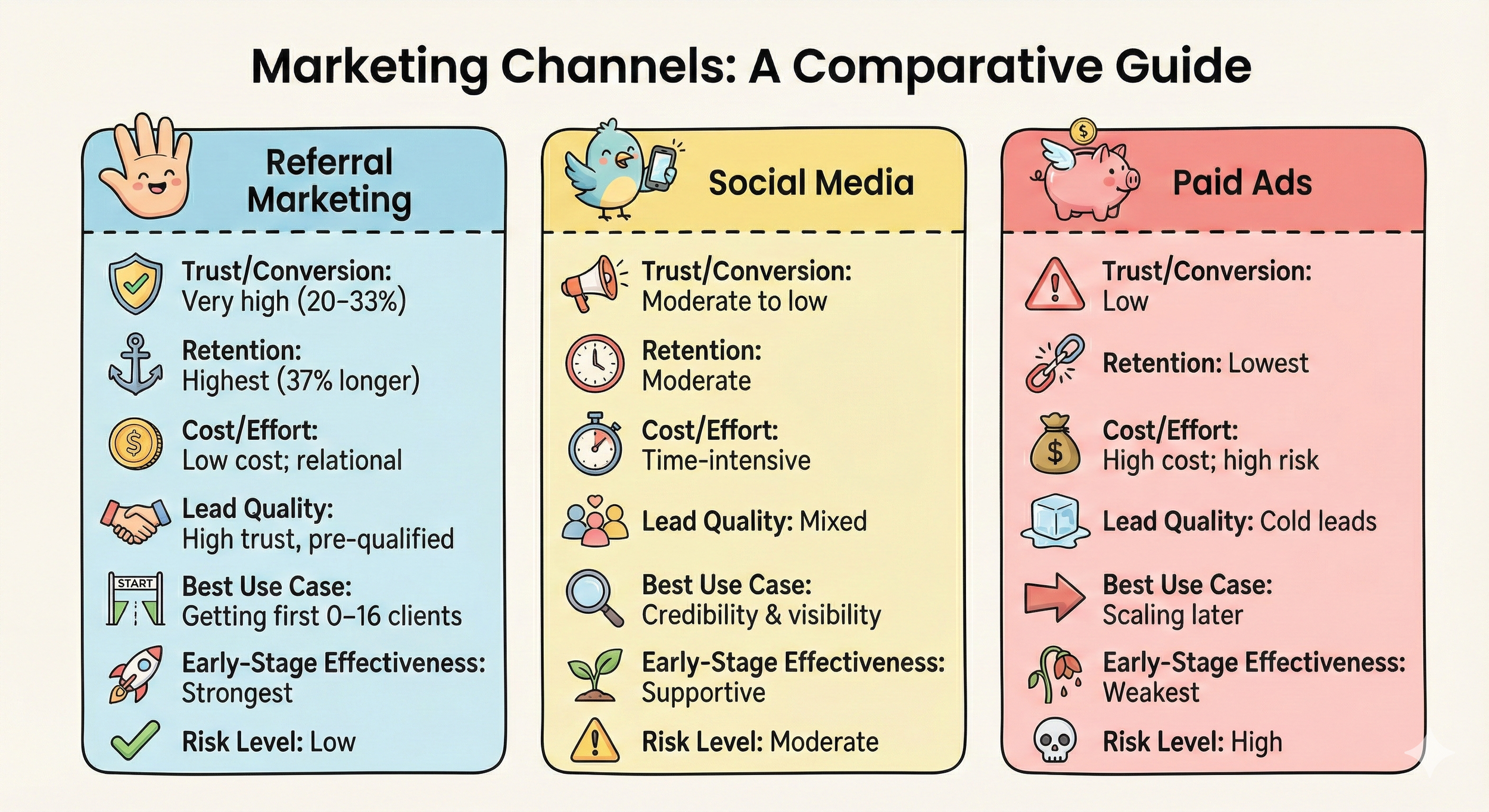
Here’s my summary (with AI’s help) of how referral marketing compares to social media and paid ads for early-stage coaches and tutors, based on the sources listed at the end of this post.
Why Referrals Beat the Hustle
When you look at this chart, the pattern is pretty striking: referral marketing wins on almost every metric that matters for early-stage coaches—trust, conversion, retention, and risk.
Referrals from our trusted colleagues aren’t just “another channel;” they’re people who arrive already warm, already somewhat convinced, and often already pre-sold by someone they trust.
Referrals convert at much higher rates than cold leads because they borrow trust from the person who recommended you. Instead of spending weeks proving you’re legitimate through social media posts and ad funnels, you start the relationship several steps ahead—“If my friend/school counselor trusts you, I probably can too.” That built-in trust is why referred clients tend to sign on more quickly and stay longer.
Referrals are also dramatically cheaper in both money and nervous-system energy. You don’t pay for impressions or clicks that may never turn into real conversations; you’re rewarded when real humans say yes. Most of the “cost” is relational: sending thoughtful check-ins, being genuinely helpful, and staying visible to the people who already like your work.
Finally, referral partners quietly do a lot of qualifying for you. They know which families are likely to value this kind of support, which students are a good fit for coaching, and who can realistically afford your services. That means fewer draining “convince-me” calls and more conversations with people who are primed to say yes.
Phew! Sounds good right?!
And just so you know— the high conversion rate of referral partnerships isn’t just true in finance and professional services. Turns out a very recent education‑sector report on enrollment and conversion also found that word‑of‑mouth, feeder‑school relationships, and other referral-style channels outperform social‑only approaches for bringing in new students.
✋ Other Avoidance Patterns That Create Unnecessary Hustle
And yet, even with results like these, most coaches drift away from spending time seeking out strong referral partner relationships, and slide back into H.U.S.T.L.E.
Here are a few more “Hyperactive, Unstrategic, Tasks Leaving Everyone Exhuasted” activities I find myself and other coaches doing instead of building referrals (just in case you need more proof that we resist relational marketing like the plague).
A. Busywork That Masquerades as Productivity
Instead of having one slightly-scary conversation with a real human, it suddenly feels urgent to redo the website font, tweak the logo, or rewrite the “About” page for the fifth time. Branding, websites, and polished visuals can matter later, but in the early stages they mostly eat hours that could have gone to emailing five people who already know and trust you.
The same thing happens with content: it feels safer to batch-create reels, blog posts, or newsletters than to follow up with the parent who said, “We’ve been meaning to reach out.” Content is great once you have momentum; at the beginning, it’s often a socially acceptable way to avoid outreach.
Over-planning is another flavor of this—perfecting systems, spreadsheets, or CRMs instead of sending simple, imperfect check-ins.
Does any of this sound familiar to you?
B. Financial Decisions That Crank Up the Pressure
Then there are money choices that quietly turn up the scarcity dial. Renting office space before you have a reliable client base can feel like “stepping into your CEO era,” but it also adds a monthly bill that your nervous system now has to meet. The more pressure you feel, the easier it is to chase every shiny tactic and sprint harder on the content treadmill.
Mailers, glossy brochures, and other expensive printed materials fall into the same category. They look professional, but without a relationship behind them they’re low-conversion and high-cost. The result is more stress, not more students.
And lest you think I’m exaggerating here—“People don’t really dive into these things before they’ve gotten their first client…right?”—they absolutely do. I watched one aspiring coach spend thousands of dollars on an office space they didn’t yet have the marketing skills (or systems) to fill, and another pour money into mailers advertising her services in a particularly wealthy ZIP code. Neither worked. Both eventually came back and said, “Fine. I’ll try referral relationships now.”
C. Bypassing Relationship-Building
Finally, there are the strategies that sound relational but actually skip the slow, human part.
Trying to land school talks before you’ve built a referral network often leads to crickets: it’s hard to get the invitation, and even harder to convert it, without warm champions behind the scenes. Launching groups too early does something similar—groups require many people saying yes at once, which is nearly impossible without a base of 1:1 relationships.
Even the “give me referrals” mindset can backfire. When partners feel like names on a list instead of humans in a mutual relationship, they quietly pull away. Sustainable referral ecosystems grow from genuine, two-way benefit—not extraction.
All of these patterns have the same throughline: they let us feel busy and “serious about the business” while keeping us safely away from the vulnerable, regulated work of being human with other humans.
In other words, they keep feeding the H.U.S.T.L.E. instead of the relationships that actually fill your practice.
Starting a coaching biz is hard. Scaling one without burnout is harder.
Real talk from our founder — Free "Ready to Rock Your Biz?!"" Videos are in the library.
Sign Up Here for the Free Library →Ditch Hustle, Choose Human
By now you’ve seen how easy it is to slide into H.U.S.T.L.E.—Hyperactive, Unstrategic Tasks Leaving Everyone Exhausted. Hustle is what happens when we chase every tactic, over-post, over-tinker, and over-spend just so we can feel “busy,” instead of tending the few human relationships that actually bring in clients.
So what’s the alternative?
I invite student-facing coaches to consider shifting from H.U.S.T.L.E. to H.U.M.A.N.—Heart‑Led, Unhurried, Mutual, Authentic, Nurturing.
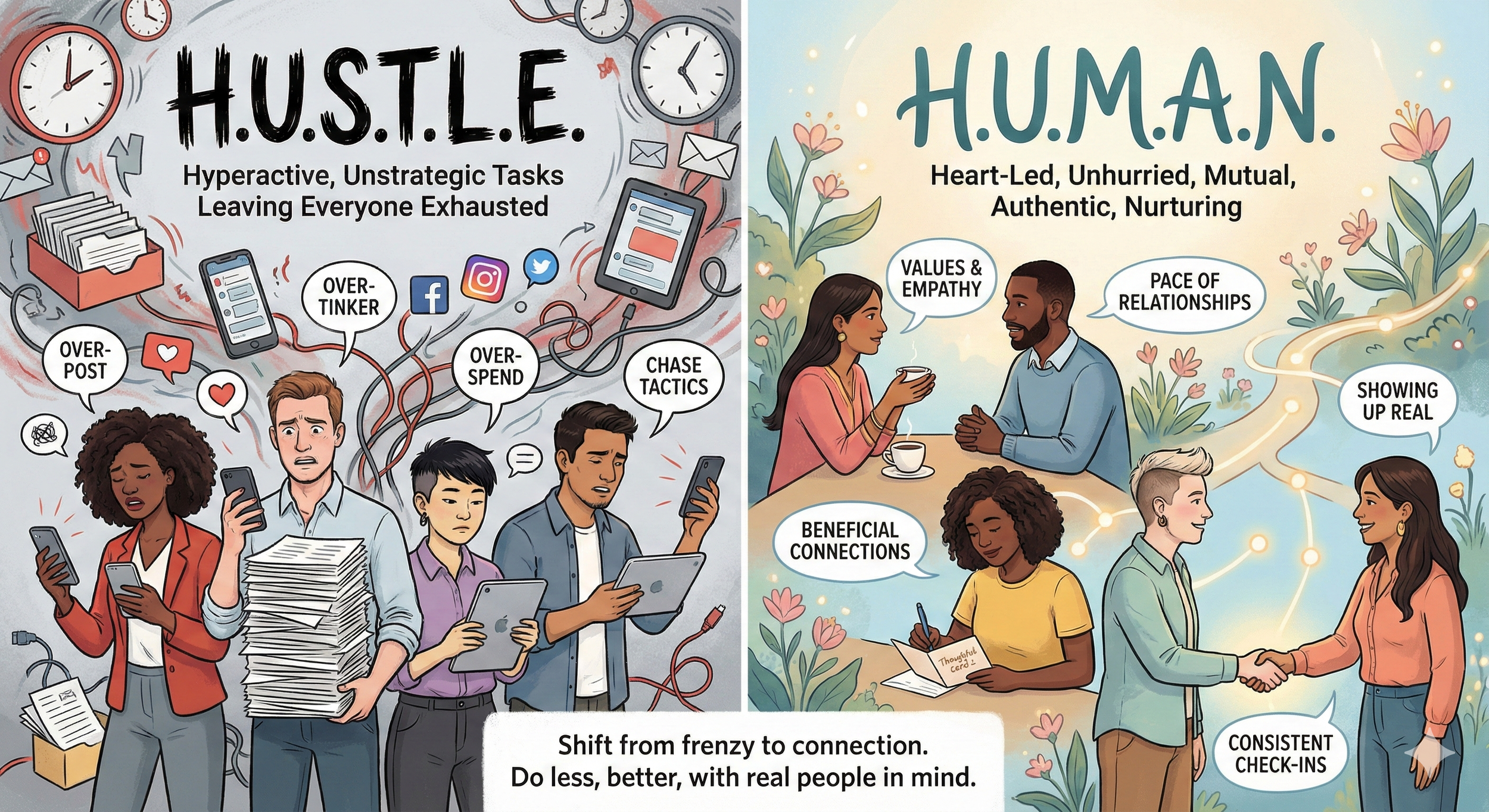
Instead of doing more and more, HUMAN marketing is about doing less, better, and with real people in mind.
Heart‑Led: You let your values, empathy, and genuine care for students and families drive your decisions, not fear or FOMO.
Unhurried: You move at the pace of relationships, not algorithms—steady outreach beats frantic sprints every time.
Mutual: You build connections that benefit everyone involved, so referral partners, schools, and colleagues are genuinely glad to send people your way.
Authentic: You show up as yourself in emails, conversations, and collaborations, instead of trying to sound like a slick marketer.
Nurturing: You stay in touch over time—small, consistent check‑ins, thank‑yous, and updates that keep you top‑of‑mind when a student needs help.
Doesn’t that sound so much better? I notice my nervous system settling as I write!
Most educators who are transitioning into being an academic or executive function coach are mid-life professionals in a career change.
If you’re going to do this work for the rest of your life, what would you rather — to be hustle or to be more human?!
Ready to Practice the HUMAN Way?
You didn’t become a coach because you dreamed about being a marketer. And yet maybe here you are, pushing harder and harder to get your first few (or next few) clients, watching your energy drain instead of grow.
If that feels familiar, you’re exactly who my new live masterclass, Beyond Hustle, is for.
Beyond Hustle is a 2-hour, anti-boring marketing masterclass where we will:
Turn everything in this post—H.U.S.T.L.E., H.U.M.A.N., referrals, and relationship marketing—into a simple, doable plan for your real-life business.
Help you map “the least you need to do” to build a steady flow of student clients.
Guide you to identify your 10 strongest referral partners for 2026.
Practice relational, non-salesy outreach scripts so you’re not just nodding along…you’re actually taking action.
If you’re reading this before December 12, 2025, you’re warmly invited to join us for this very low cost masterclass.
To join the live, low-cost Beyond Hustle masterclass (if it hasn’t happened yet), click here.
If you’re reading this after December 12, 2025, don’t worry—you haven’t missed your chance to go deeper. Inside the Lab’s FREE Visitor’s Center, you’ll find a full biz-building course (including referral-based marketing tools) that you can start now, plus opportunities to join future masterclasses as they’re announced.
To get immediate access to the FREE Rock Your Biz overview course inside our Visitor’s Center (if the masterclass date has passed or you want more support about MORE than just marketing).
Either way, if you’re ready to ditch hustle and choose HUMAN, you’re invited to take the next step with the Anti-Boring Learning Lab!
🔍 Research & References
Here are some of the articles I found to help me ground my reflections above in what others are saying.
Referral Marketing
• Nielsen Trust in Advertising Report (2022)
• Viral Loops Referral Program Benchmarks (2024)
• AreteCoach Case Studies (2024)
• NACVA + Hinge Referral Marketing Study (undated)
• StepEx Industry Benchmarks (2025)
Social Media & Ad Effectiveness
• Umbrex — Social Media Referral Traffic Analysis (undated)
• Wiley Consumer Behavior Journal (2023)
• Anhco.org — Referral vs Ads for Coaches