
We Asked Academic Coaches to Assess Themselves. Here Are the Results.
When was the last time anyone asked you to honestly assess your coaching skills? Not your students' progress. Yours.
I asked that question—sort of—during a webinar I ran last week called Meh to Motivated. I'd just built a self-assessment tool called the Anti-Boring Skills Snapshot, and the webinar was the first time I'd ever put it in anyone's hands.
After walking through each of the seven coaching moves on the rubric, I asked people to share where they were and where they wanted to grow. I figured most folks would keep that private. After all, why would anyone broadcast their weak spots to a room full of peers?
Nosiree. The chat lit up. Coaches were sharing their scores openly, willingly, enthusiastically.
And watching that happen, I wondered: is this because coaches in general are hungry for this kind of honest self-reflection? Or is it because the people who are drawn to the Anti-Boring Learning Lab—whether they're longtime members or strangers who wandered in for the free, high-quality learning—are specifically the kind of people who want to think this way about their practice?
Honestly, I'm not sure it matters. Either way, the hunger is real.
Where else does that happen in this field? I genuinely don't know of anywhere. Academic and executive function coaching is a growing industry, but honest peer assessment of coaching skill, including naming challenges areas as well as strengths? I don’t see that kind of rigorous vulnerability in enough places.
When coaches started sending me their completed snapshots after the webinar, I realized I was sitting on something incredibly rare: real, raw data on the skills side of coaching. It’s a first step toward building a true picture of how we actually show up for students, and where EF and academic coaching mastery actually lives right now.
Are you as curious as I was about what the Learning Lab data said? Let's look at it—with the caveat that this is a first round. I'm still working on building a more complete dataset, and the patterns I'm noticing are just that: patterns, not conclusions. Which is exactly why I'd love your data, too (more about that soon).
What the snapshot actually measures
So that you understand the data I’m about to share, here’s a brief rundown of what my rubric actually assesses.
The Anti-Boring Skills Snapshot asks coaches to rate themselves on 5 core coaching moves — plus 2 bonus ones — using a 1–4 scale: Rarely, Sometimes, Usually, Integrated.
The five core moves, and the question each one asks you to sit with:
Teach Cognitive Science — How often do I understand, and explain, the science behind the strategies I share?
Be Concise — Do I share the least students need to know to get into effective action?
Teach with Consent — Do I check in about student willingness before I teach, solve, or reassure?
Stay Curious — To what extent do I ask empowering questions that nurture habits, skills, and identities?
Chart Progress — Do I have tools to visualize progress other than grades, and do I use them regularly?
And the two bonus moves (not actually “coaching moves” but still important):
Toolboxes not Curriculum — How comfortable am I letting go of the plan and trusting my tools?
Embrace Community — How readily do I choose belonging over self-sufficiency in professional life?
What I love about this rubric — and what I didn't fully anticipate when I built it — is that you rate yourself twice: where you are now, and where you want to go. That gap is often where the most interesting self-knowledge lives.
Here’s an example of how our digital assessment helps visualize the gap on a radar chart:
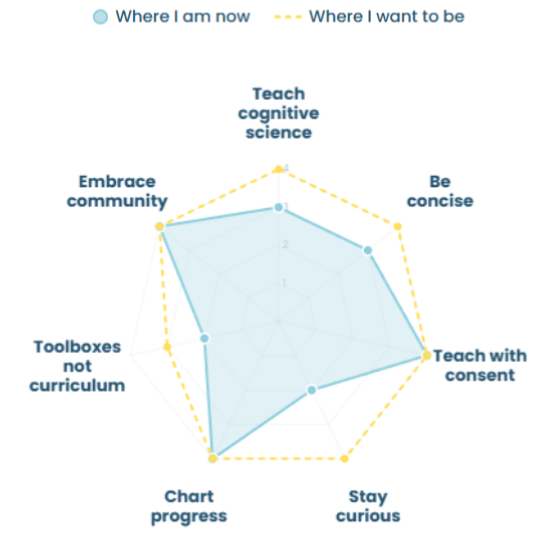
Isn’t that a fun snapshot?! I’m endlessly fascinated by these, and I’m so excited to share some initial results with you. But first…
Want to add to the data?
Before you read what we found, I'd suggest taking the snapshot first. The findings will land differently once you've thought about where you are.
The snapshot is free to take — and if you want to contribute to what we're building here, we'd genuinely love your results. Here’s how to send them to us:
Fill out the digital assessment
Screenshot your scores
Email the screenshot to officewiz@antiboringlearninglab.com.
As a thank you for taking the time to send us your results, we’ll reply back with a 10% off coupon for our summer programs.
Fair warning: we don't have a fancy data-collection system yet, hence the screenshot-and-email situation. We appreciate your patience with our very human process.
And now, on to the results:
What we found — and what it means for you
Below are four of the most interesting findings we noticed when we crunched the data from the coaches who’ve already shared their snapshots with us (though we can’t WAIT to see what data you might add to the mix!).
Just so you know, the group includes three kinds of respondents:
longtime Lab members who have been with us more than three years,
coaches who have finished the Anti-Boring Certification with the last 1.5 years, and
coaches who haven't joined yet or started our certification.
That last category matters — it means we got to see the snapshot the way a newcomer sees it, without the context of having worked inside the framework, and compare it to those who are at different stages in their relationship to the Anti-Boring Toolkit.
The contrast was instructive. Read on!
Finding #1: Almost every coach named the same gap
No matter the experience level, membership status, or coaching context, one move showed up as the lowest or most-wanted growth area across nearly every snapshot: Chart Progress.
Chart Progress is about having a concrete, visual system for tracking student habits and growth — something beyond grades. Not just knowing you should track, but actually having a tool students can see, use, and eventually own themselves.
Coaches who've been in the Lab for years named it as a gap. Brand new members named it. Coaches who haven't joined yet named it. In their own words: "charting," "tracking progress," "working more on tracking habits," "tracking data."
But here's what's interesting: they're naming the same gap for completely different reasons.
Coaches who haven't yet trained with us don't have a proven system yet. They know they should be tracking something — they just don't have a concrete, repeatable process that actually works with real students. That's the gap.
Coaches who have been through the Lab training are in a different place entirely. They've learned the Habit Tracker — our core tool for making student progress visible — but they're still deepening their fluency with it.
The Habit Tracker is one of the most complex tools we teach, and there are genuine layers of understanding that coaches move through over time. Learning it initially is one thing. Getting it working smoothly with a range of students, in different contexts, across a full school year — that can take a few years of real practice. So when experienced members name Chart Progress as something they want to improve, they're not saying they missed something. They're saying they can see further than they could before.
The highest level of this skill looks like this: your student owns the tracking process so completely that they ask for it if you forget. That's a high bar — and it's one worth working toward.
If you recognized yourself in either group, you're not behind. You're just at a different point on the same path.
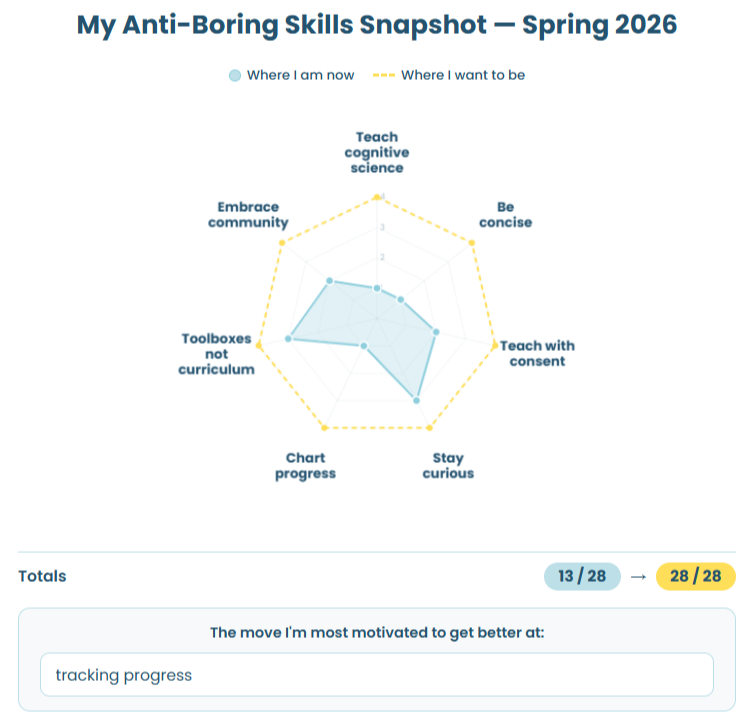
Description of the snapshot: A coach before the training. Notice the uneven, spiky shape — strong in one or two areas, low in others. The gap between the blue "where I am" and the yellow "where I want to be" is large. This is what it looks like to have real strengths and real gaps, but no shared framework yet for understanding either.
Finding #2: There's something specific that non-members are missing — and members aren't
This I didn’t expect! It turns out that one of our 7 coaching moves was consistently self-assessed lower by folks who hadn’t started the training yet — and higher by almost everyone who had. That means we’re doing a pretty darn good job teaching this skill, and it is: Teaching with Consent!
This is the move that asks: before I offer advice, teach a strategy, or jump in to solve a problem, do I check whether my student is actually ready to receive it?
In the Lab, we use a simple 3-part framework to teach this coaching move called “The Consent Burger.” Here’s a quick visual:
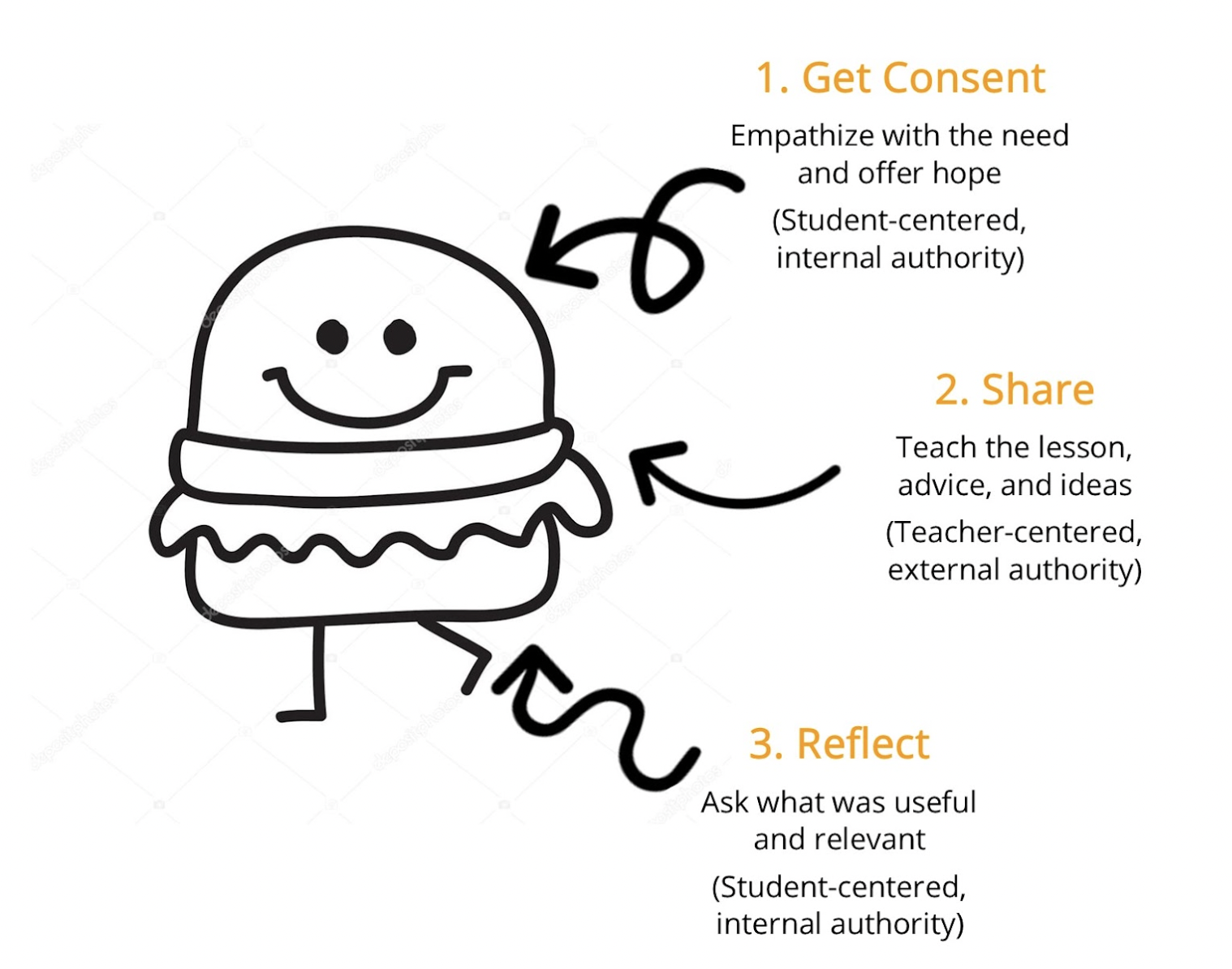
Teaching with Consent may sound and look simple. In practice, most of us skip it. We see a problem, we know a solution, and we offer it. The student nods. Whether they’ve truly internalized the idea — or even wanted it in the first place — doesn’t usually matter.
Multiple coaches outside the Lab named Teaching with Consent as a priority area for growth. Among members, it barely appeared as a skill they wanted to work on — not because consent stops mattering once you join the Lab, but because members have practiced it enough that it’s no longer the thing they’re most consciously working on. It’s moved from effortful to natural.
We teach this move in the Anti-Boring Learning Lab in so many different ways:
Via direct instruction: We have a teaching video devoted entirely to Teaching with Consent.
Via modeling: Watch Gretchen work directly with students using a consent-based process.
Via role play: Come to our “mini-lecture practice” sessions and rehearse the three steps of the Consent Burger.
Via practice with real students: We ask you to try teaching the Anti-Boring Toolkit to real students in your own world, using the Consent Burger to establish willingness and structure your metacognitive questions afterward.
Via case studies: Join a live community call and troubleshoot real student situations together.
The fact that so many newer coaches rate themselves lower on consent, while so many Lab members rate themselves higher in this skill, is a real win. It’s clear that in the Lab, you don’t just learn the moves — you practice them enough that they stop feeling like moves at all.
Finding #3: How you talk about growth changes the longer you're in the Lab
One of the things I’m most proud of in how we designed the Anti-Boring Skills Snapshot is that it asks two questions, not just one:
“Where are you now?” and
“Where do you want to grow next?”
That second question matters deeply. In the Lab, we firmly believe that coaches who help students grow should be growing themselves. To ask that of our students without doing it ourselves would mean we're out of integrity.
So when I looked at the data, I paid close attention not just to where people scored themselves today, but where they said they wanted to go. What I noticed was a clear, meaningful difference between coaches who haven’t yet trained with us and those who have.
Coaches who haven’t done the training yet tend to aspire to a perfect score across all seven moves. That aspiration is genuine and absolutely worth honoring—it reflects a deep desire to grow and a clear awareness of the gaps they want to bridge. But it’s also the “I want to be perfect” aspiration of someone who hasn’t yet started traveling the actual anti-boring terrain.
Once you begin testing these moves in real sessions with real students, your goals naturally become more precise, grounded, and realistic. You stop trying to max out every single metric and start focusing on the exact levers that will move the needle for your unique clients.
Take a look at these two radar maps side-by-side to see exactly what I mean:
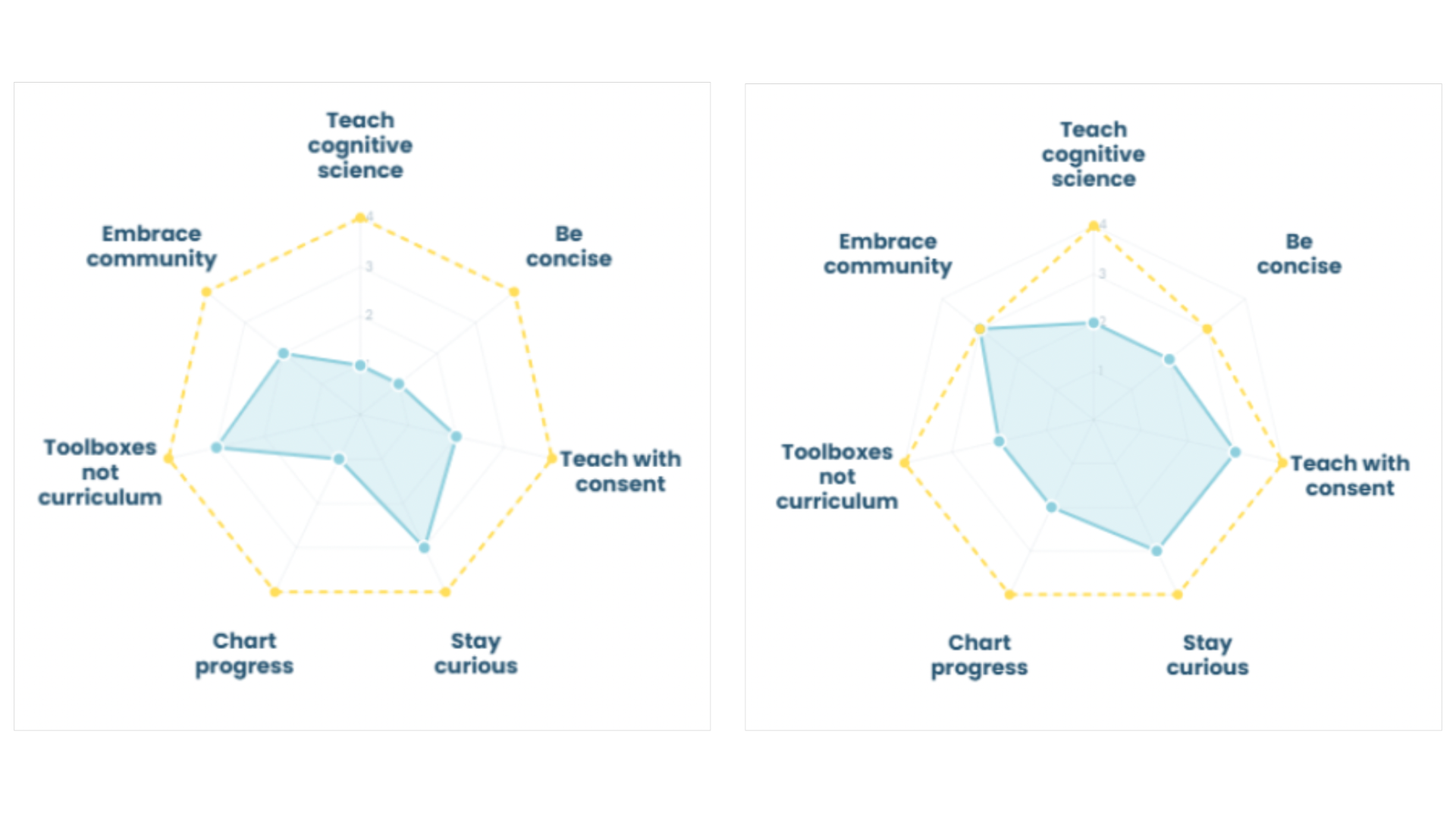
The map on the left is from a coach who hasn’t (yet) joined the Lab. Do you see how they aspire to perfection, aiming for a 4/4 on every single move?
The map on the right is from a coach who received her certification about a year ago and is still in the Lab, actively honing her academic and executive function coaching skills. I absolutely love that there are a couple of moves where she’s not shooting for a 4/4. She’s being completely realistic about exactly where she wants her growth to happen next.
That shift from "perfect" to "focused" is exactly what happens when you move from theory into real, transformative practice, and I’m so proud that we facilitate that in the Lab.
Finding #4: Real mastery looks like a spiral, not a straight line.
Plot twist! Sometimes the most expert thing you can do is intentionally lower your own score.
Take, for example, the Anti-Boring Skills Snapshot of a coach whose been hanging out in the Learning Lab since 2019. Of all the academic and executive function coaches I've trained, she's basically the gold standard for teaching students the Anti-Boring Toolkit with pure fidelity.
But her chart has a giant, beautiful quirk. Do you see it?
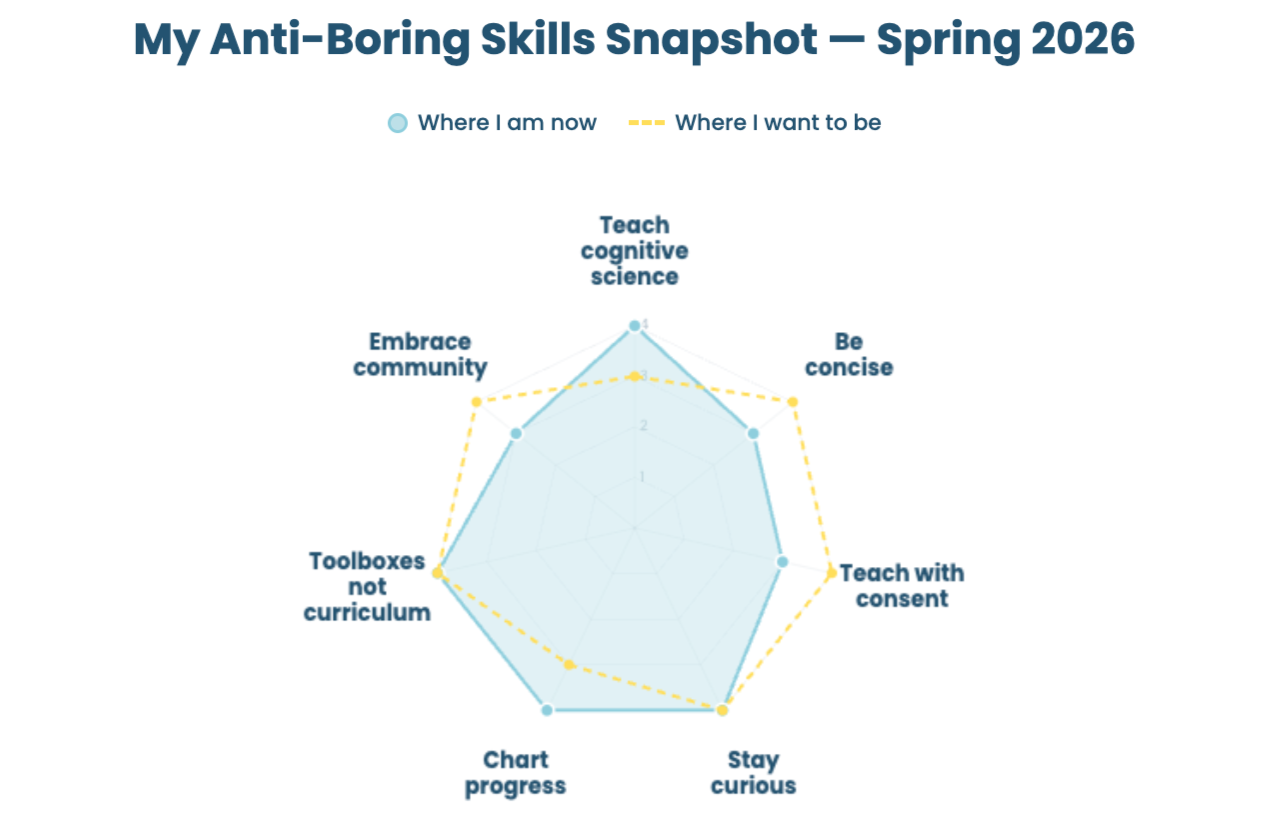
You’ll note that the blue shape (where she is now) is nearly full—the sign of someone who has deeply integrated these coaching moves into her practice.
But look closely at her yellow "where I want to grow next" line. For two of her points (Teach Cognitive Science and Chart Progress), it's actually lower than her blue line! When I asked her why she was intentionally aiming lower, she told me about a total lightbulb moment from our “Meh to Motivated” workshop.
Another member had mentioned wanting to get better at teaching the science of learning to teenage boys who don't always buy into our visual, brain-based explanations. That coach noticed some students respond way better to hard data—the kind of statistics that make the case undeniably.
Data such as: according to one study, students who practice retrieval remember 50% more than students who just repeatedly restudy. 50% more!!?? Impressive, huh?
It’d be pretty amazing to have a bunch of these facts in your back pocket for skeptical students, and this veteran coach is ready to arm herself accordingly next school year—seeking out impressive data points and delivering them in ways that really wow them.
That is not a beginner goal. That's a master practitioner choosing to layer a new variable onto a skill she’s already mastered.
Our rubric describes the highest level of any move—what we call Integrated—as being “embodied, fluent, mentoring others—and full of new questions.” That's exactly what her chart shows. She didn't rate herself lower because she slipped backward; she rated herself lower because her new questions are driving her to grow in a whole new direction.
That's what we're building toward in the Lab. Not a finish line. Just the next anti-boring move.
How we’re using this data to level up this summer
One of my absolute favorite parts of running the Lab is that we get to treat our community like a living, breathing laboratory. When I looked at the Snapshot data and saw a massive wave of you saying, "Yes! I want to get way better at charting student progress!" I knew we had to seize the moment.
So, this summer's cohort is getting a brand-new, special training all about the Habit and Grades Tracker!
I’ve already reached out to some of our veteran Lab members who have deeply integrated the Tracker into their sessions, and we’re setting up an awesome "show 'n' tell." They’re going to walk us through exactly how they’ve been using the tool—and how they’ve customized and improved upon it. (Which I actively encourage, by the way. We are co-LAB-orators, after all!)
I am so pumped to get under the hood of this tool together and turn it into a tangible, practical skill we can all master.
If you took the snapshot and recognized yourself in any of this data—the spiky chart, the big aspiration gap, or that nagging sense that you should be tracking progress but don't quite have the system down yet—this is exactly what we're going to tackle.
Ready to close your gap this summer?
If you are ready to jump in and tackle your next growth area this summer, we'd love to have you. Here’s more info about the summer cohort:
Not quite ready to commit to the full cohort yet? No worries! You can still grab some excellent tools to experiment with on your own:
Because at the end of the day, students deserve the "just right" tools to go from Meh! to Motivated!—and as a coach, so do you. Thank you for being out there on the terrain, helping neurodiverse students decode their brains, build life-changing habits, and truly thrive.
Your Turn
If you took the assessment, I’d love to hear — Did anything in these findings match your own snapshot — or surprise you? Which of the seven moves feels most alive for you right now, and which one keeps slipping? Share in the comments. We read every one, and the patterns you name here often become the next thing we build together.