
Welcome to the
Anti-Boring Blog
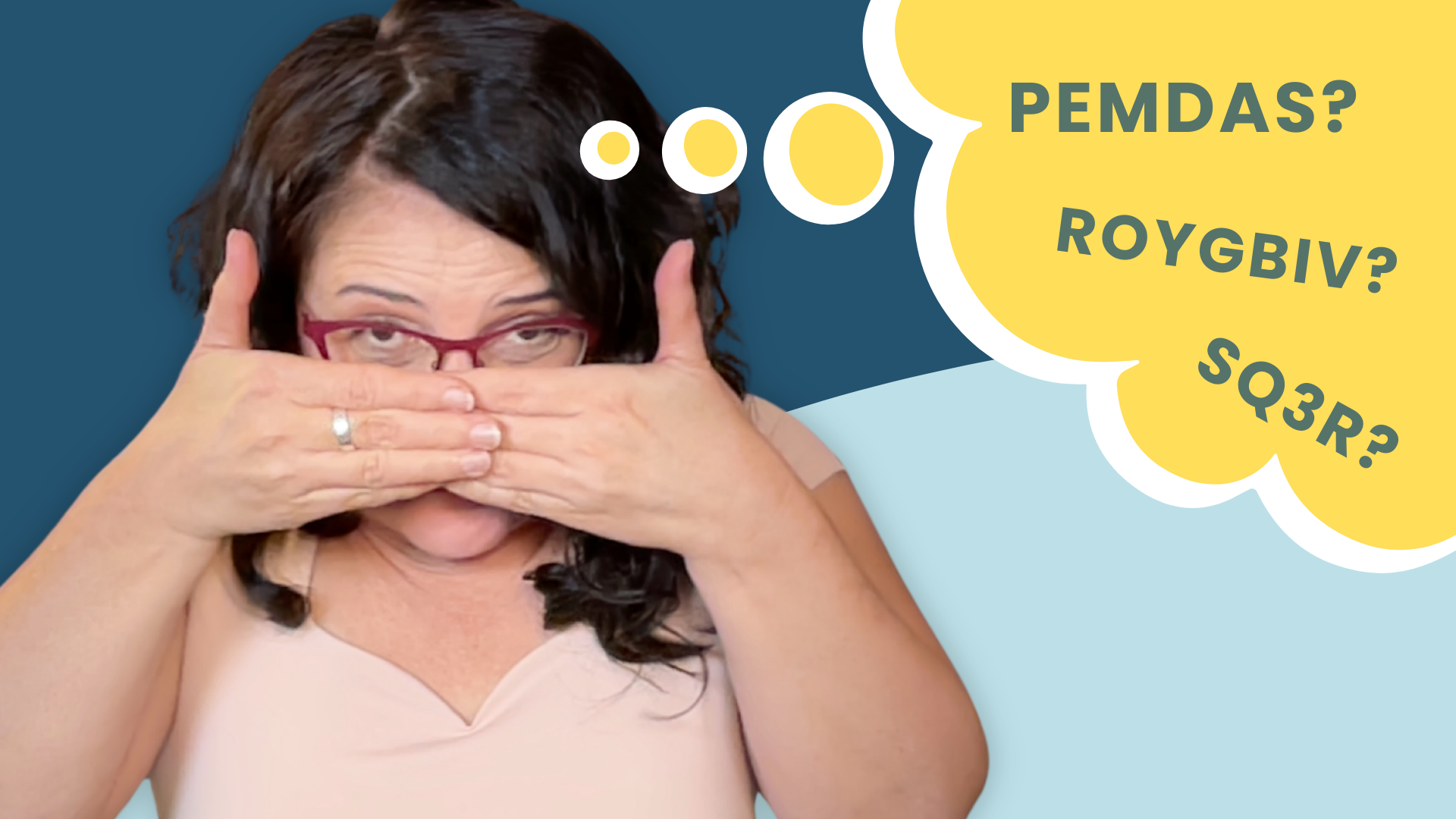
Do Mnemonics Count As “Teaching Students How to Study”?
In this post I tackle a question I hear all the time from educators and coaches:
“Do mnemonics really count as teaching students to study?”
If you’ve ever wondered the same thing, you’ll want to see this one.
Here’s the short version:
Mnemonics do work — but only in certain contexts.
They’re great for remembering facts, lists, or vocabulary… when used alongside strategies like retrieval or elaboration.
But when they’re used for complex ideas? They can actually get in the way of deep learning.
I share when and why mnemonics work, when they don’t, and how to help students build their own—so they understand the why behind the memory trick.
Why Students Don’t Use the Awesome Study Strategies We Teach Them
We all have things we know we should do — drink more water, get eight hours of sleep, take breaks from screens — but knowing doesn’t always translate into doing.
It’s the same for students when it comes to studying.
Teachers, parents, and student coaches see it every day: students don’t study effectively. Many rely on rereading and highlighting because those methods feel productive. But even when students do know about better strategies, they often don’t use them. That’s what I call the Awareness–Use Gap — and it’s one of the trickiest challenges we tackle in the Anti-Boring Learning Lab.
Awareness isn’t enough. Many students don’t even know what makes learning effective — and even when they do, they often fall back on rereading and cramming.
Research shows scaffolding is essential. Students are far more likely to use effective strategies when educators model them, build them into assignments, and provide accountability.
The Anti-Boring Learning Lab equips educators to close the Awareness–Use Gap. We train teachers, tutors, and executive function coaches in science-backed tools and study skills that stick, so students actually follow through.

Is Memorization the Enemy of Critical Thinking? Here’s the Science
Is memorization really the enemy of critical thinking, creativity, and problem-solving — or is it actually the foundation that makes these skills possible? In this post, we explore how retrieval practice and the Study Cycle transform memorization from “rote learning” into a launchpad for higher-order thinking. You’ll discover new research proving that self-quizzing and other memory strategies don’t just boost recall — they help students transfer knowledge, recognize patterns, and apply ideas in real-world contexts.
Perfect for academic coaches, executive function coaches, tutors, and classroom teachers, this article shows how to integrate science-backed study skills into everyday learning without “teaching to the test.” Whether you support neurodiverse learners or want practical tools to inspire critical thinking, you’ll learn why memorization and higher-order learning aren’t opposites at all — they’re powerful partners in building flexible, resilient learners.

When Brains Get Flooded: Cognitive Overload in Neurodivergent Learners
Cognitive overload happens when the brain’s working memory has more on its plate than it can handle. This overload affects focus, processing, and memory.
For neurotypical students, overload may cause frustration or brief disengagement, but they often reset quickly with scaffolding or a break.
For neurodivergent students, overload hits harder and lasts longer; what looks like misbehavior may actually be self-protective. Explicit supports and permission to pause are vital.
Let’s explore what’s going on when students “check out” mid-task—and how we can respond in ways that restore learning, not shut it down.


From Crisis to Capacity: Triage versus Proactive Student Coaching
Learn how to coach students more effectively by using the Triage vs. Proactive Coaching framework. This summer, deepen your executive function toolkit with flexible, brain-based PD inside the Anti-Boring Learning Lab—designed for educators who want to help students build sustainable academic habits.


Fixing Finals: Mistakes Educators & Students Make at Exam Time
Discover common finals prep mistakes students, teachers, and academic coaches make—and how brain-based strategies can help fix them.


